Emergency Garage Door Repair Near Me: What San Marcos Homeowners Should Do First
When your garage door won’t open at 7 a.m. on a workday, or worse, won’t close at 11 p.m., the first thing you need is a clear answer: here’s what to do in the first ten minutes. Shut off the opener, check for visible damage like a snapped spring or frayed cable, and do not force the door open or closed. If the door is stuck halfway, it’s usually a broken torsion spring or a door that has slipped off track. Both are repairable same-day for most San Marcos homes, and both get more expensive if you keep hitting the opener button. If you’d rather not sort it out yourself, call San Marcos Garage Door Service at (877) 265-5166 and we’ll walk you through it.
Here’s the part most homeowners miss: when a torsion spring snaps on a two-car door, the door doesn’t fall. It just stops working. But if you try to manually lift it anyway, you can snap the cable, bend the track, and turn a $350 spring replacement into a $900 repair. The first three minutes matter more than most people realize. This guide covers exactly what to do, scenario by scenario.
The Four Emergencies We See Most in San Marcos
Most emergency calls we take fall into one of four categories. Here’s the safety triage for each, specific to what we actually find in San Marcos garages, not generic advice.
1. Broken Torsion Spring
You’ll know this one instantly. It sounds like a gunshot inside the garage. The door might be up, down, or stuck mid-way. What you should do: stop using the opener immediately. Unplug it from the ceiling outlet. A door with one broken spring puts uneven load on the remaining spring, the cables, and the opener’s gear assembly. Keep running the motor and the gears strip, adding a $200+ opener repair to the spring replacement. Manually lifting a door with a broken spring is a genuinely dangerous move. Those springs are under enough tension to break bone. The right call is to leave the door where it is and call a specialist. Spring replacement in San Marcos typically runs $250 – $380 for a standard two-spring setup on a 7-foot door, labor included. We replace both springs, not just the broken one, because the second spring is the same age and will fail within months. Most manufacturers design springs for about 10,000 cycles. If you own the home and have opened the door 4 times a day for 8 years, the second spring owes you nothing.
2. Snapped Cable
A snapped cable is easier to spot than a spring failure: you’ll see a frayed steel strand hanging loose or the door sits uneven in the track, one side higher by an inch or more. The danger here is less about tension, more about the door jamming. If you keep running the opener, the door can wedge diagonally, pop a roller out, and bend the vertical track. That bends a $120 service call into a full track replacement. Shut it down, unplug, and visually check both sides of the door for hanging cable. If you can see a dangling wire, don’t close the door manually. That cable loosely wrapping around the drum as the door moves can carve a groove into the drum. San Marcos homes near the coast see more cable corrosion than inland, thanks to marine air, but most cable failures are just age and strand fatigue.
3. Door Off Track
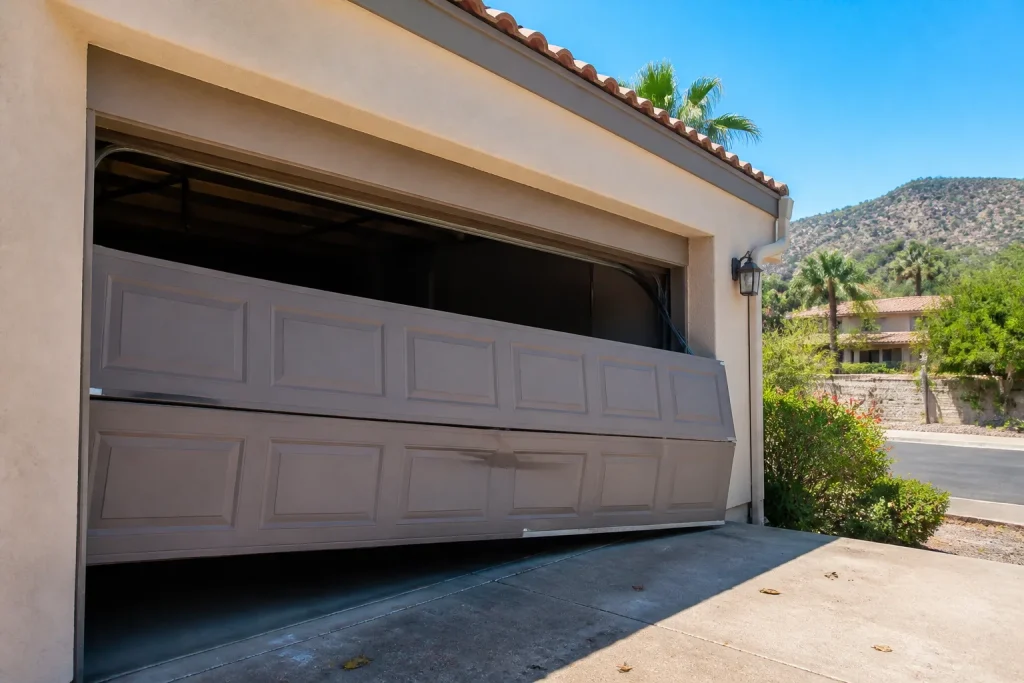
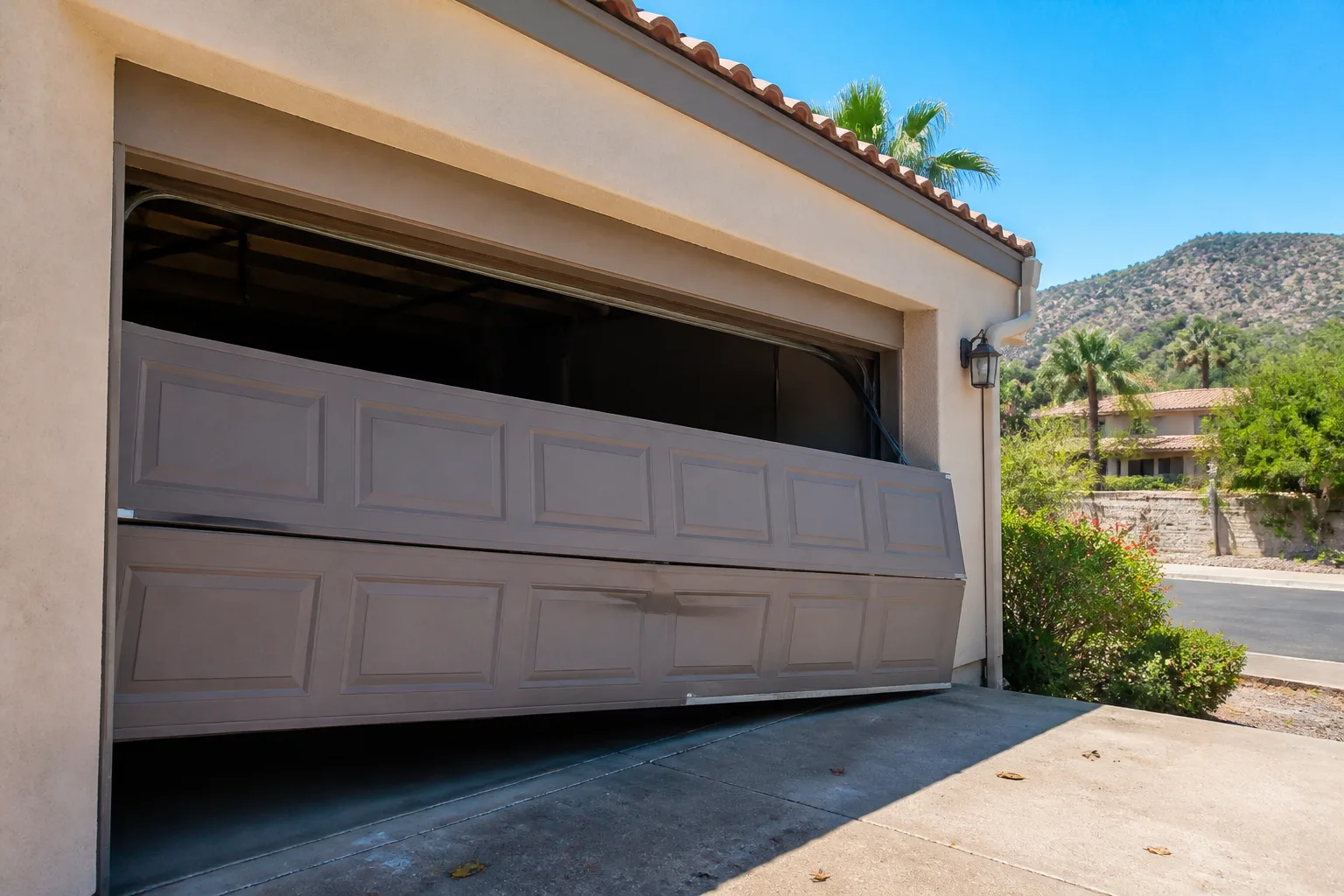
An off-track door has at least one roller that has left the track channel. You’ll see a gap between the roller and the track rail, or the door sits visibly crooked. The safety triage: do not push it. Homeowners sometimes try to muscle the door back into place. The result is usually a bent panel or a track section that then has to be replaced. An off-track door is repairable same-day in most cases, but only when the door is properly braced before the roller is reset. The industry fix is to use winding bars to relieve tension, reset the roller, and verify the track alignment. That’s not a YouTube DIY project. The repair itself usually runs $180 – $300 depending on whether the track section is damaged or just needs realignment.
4. Vehicle Trapped Inside
This is the one where people panic. Car in the garage, door won’t lift, you need to leave. Here’s the thing: if the spring is broken, manually lifting the door is dangerous and often impossible without equipment. If the opener is the failure point, not the spring, you have a better option: the red emergency release cord. Pulling that cord disengages the door from the opener carriage. You can then manually lift the door, though a two-car door without spring assistance weighs 150 – 250 pounds and gets heavy fast. One specific configuration where pulling that cord makes things worse: if the door is stuck halfway up and the spring is broken, pulling the release cord removes the only thing holding the opener carriage in tension. The door can slam down. In a spring-failure situation, leave the cord alone. If the door is fully closed and the spring is intact, the release cord is a safe way to get your car out. San Marcos homeowners in this spot can call us and we’ll walk through the door position, the spring shape, and the cable condition to determine whether that cord is safe for you to pull. That’s a free phone call, and it beats a hospital visit.
How to Manually Operate Your Door When the Opener Fails
If the springs are intact and only the opener has died, manual operation is straightforward and safe. Here’s the correct sequence, and the one thing people routinely get wrong.
- Unplug the opener from the ceiling outlet. This prevents the motor from activating while you’re handling the door. If you can’t reach the outlet, turn off the breaker that feeds the garage.
- Find the red emergency release cord. It hangs from the opener rail, usually near the motor unit. Pull it straight down, sharply. You’ll hear the carriage disengage.
- Lift the door by the handle, not the top edge. A properly spring-balanced door lifts with about 8 – 10 pounds of effort. If it feels like a deadlift, stop and call us. That’s a spring problem, not an opener problem.
- To re-engage the opener: pull the cord back toward the motor and run the opener until the carriage reconnects. If you skip this step, the door will be in manual mode and the opener will just spin.
What people get wrong: they pull the cord while the door is in the up position with a weak spring. The door is heavy, unbalanced, and when the carriage releases, there’s nothing controlling the descent. The door slams closed, often cracking the bottom panel or blowing out a roller. This is the number one self-inflicted injury scenario we hear about in San Marcos garages. If you’re unsure whether your springs are healthy, call before you pull.
What to Have Ready Before You Call a San Marcos Repair Service
The faster we can diagnose, the faster a truck gets to you. Here’s what cuts the phone call from ten minutes to two:
- The brand and model of your opener. LiftMaster and Chamberlain models have the model number printed on the side of the motor unit. Genie units often have it near the light lens. Craftsman openers are usually Chamberlain rebrands with a Craftsman faceplate. This tells us what’s compatible before we roll.
- Your door brand, if you know it. Clopay, Amarr, Wayne Dalton: these three brands use different panel profiles and hinge spacing. When we know the door brand up front, we stock the right rollers, hinges, and panels on the truck.
- The door dimensions. Standard is 7 feet tall and 8 or 9 feet wide, but San Marcos neighborhoods built in the 1990s and early 2000s have a mix of 16×7 and 16×8 doors, and some custom widths. Knowing the size narrows down spring and track specs.
- What exactly happened. Loud bang, grinding sound, door moved down an inch then stopped, door sits lower on one side. Specific symptom language is better than “it broke.” A loud crack followed by a completely dead door is a spring. A grinding noise with the opener running is a stripped gear. A door that moves a few inches and reverses is a sensor or logic board issue.
One more: take a photo of the spring area with your phone. A torsion spring sits above the closed door on a metal shaft. If you can see a visible break in the coil, send the photo. That’s faster than any verbal description. We’ve had customers in San Marcos send a photo at 6:45 a.m. and have a technician at their door by 8:30.
How to Spot a Real Garage Door Specialist on the Phone
Not every company that shows up in a “garage door repair near me” search is a garage door company. Some are general handyman services that answer the phone and figure out the door when they get there. There’s an easy way to separate the two, and it takes under two minutes. Ask these three questions:
- “Do you stock torsion springs on your truck?” A specialist runs a truck stocked with the common spring sizes, cables, rollers, and hinges. A generalist often has to make a supply run mid-job, which you’ll see reflected in the final invoice as a second trip charge.
- “Which opener brands do you service?” A legitimate repair shop will rattle off LiftMaster, Chamberlain, Genie, Craftsman, Raynor without hesitation. A generalist will pause or say “we work on all of them.” The first answer comes from a parts book. The second comes from a guess.
- “Can you tell me my spring size from the door weight?” This is the telltale question. A door specialist calculates spring specs from the door’s weight, height, and drum size. A handyman just orders whatever spring “looks right.” Wrong spring tension leads to an opener burning out or a door that drifts down on its own.
Garage doors are all we do. Every tool in the truck, every part in stock, and every hour of technician training is specific to residential and light-commercial doors. That matters when you’re standing in a dark garage at 9 p.m. with a car blocked inside.
Securing the Garage While You Wait for Service
If you have a broken spring or an off-track door, the garage may be stuck open all night. That’s not just an inconvenience. It’s a six-foot-wide opening into your home’s first floor. Here’s how to lock it down:
- If the door is fully closed: If the opener still works, use the manual slide lock on the inside of the door track. If the opener is disconnected, the slide lock is the only thing keeping the door from being lifted manually from outside. Most home garage doors have a slide lock but homeowners never use it.
- If the door is stuck partially open: You can’t fully secure a partially open door, but you can reduce risk. Close the internal door between the garage and the house, lock it, and treat the garage like an exterior space. Remove visible valuables if possible. If the door is open more than a foot, wedge a 2×4 or a ladder under the open end to prevent it from dropping further.
- If the door is fully open and won’t close: This is the worst security scenario. Disable the opener so the door doesn’t move unexpectedly. If you can safely get under the door, bring a stepladder and two heavy objects, like a filled trash can, and position one on each side of the track under the door. They won’t stop force, but they block the door from sliding down on someone. Do not stand under an unsecured door. Do not crawl under it. Call a specialist that can get there same-day.
Most San Marcos emergency repair calls we run happen between 6 p.m. and 10 p.m. People come home, hit the opener, and hear the spring go. Your garage door doesn’t care about business hours. Neither do we.
When to Call a Pro (And When It’s Actually a Simple Fix)
Some garage door problems need a professional. Some don’t. Knowing the difference saves you a service call fee. Here’s our honest breakdown.
Simple fixes you can try first: If the door won’t close and the safety sensor lights are blinking, check for something blocking the beam at the base of the track. A rake handle or a leaf pile breaks the beam and the door reverses. If the remote stopped working, try replacing the battery before anything else. If the wall button works but the remote doesn’t, that’s a programming or signal issue, not a broken opener.
Do not attempt these yourself: Any job involving torsion springs, lift cables, or track realignment. These are high-tension components. There is no “quick trick” for resetting a torsion spring. You need winding bars, a torque wrench, and knowledge of the spring’s wind direction. Get it wrong and a half-wound spring can release without warning. Every year we repair doors in San Marcos that homeowners attempted to DIY and ended up with bigger bills than the original repair.
Our rule is repair first, replace only when it makes sense. A rust-rotted Wayne Dalton door with a torn bottom panel may be at the end of its life, and a new installation is the right investment. A Clopay door with a broken spring and good panels is a straightforward same-day repair. We’ll always tell you which you’re looking at before we pick up a tool.
The Bottom Line
When a garage door emergency hits, the playbook is short: unplug the opener, don’t force the door, don’t pull the release cord unless you’re sure the springs are healthy, and call a specialist who can identify the problem from your description. Specifics beat speed every time. A two-minute conversation about the brand, the symptom, and the door size gets the right part on the right truck. If you’re in San Marcos and need help now, San Marcos Garage Door Service offers free estimates and same-day emergency dispatch. Call (877) 265-5166 and we’ll figure out what you’re dealing with before you hang up.
Related services in San Marcos: Garage Door Repair in San Clemente | Garage Door Opener Repair in San Clemente | Garage Door Installation in San Clemente
Frequently Asked Questions
Most emergency repairs in San Marcos run $180 – $380 depending on the failure. A broken spring replacement is typically $250 – $380. A snapped cable runs $150 – $220. An off-track reset is $180 – $300. The emergency after-hours visit adds a trip charge that varies by time and distance. All work is quoted and agreed before we start, so the price we say is the price you pay. Call (877) 265-5166 for an exact quote.
Most San Marcos emergency calls we can dispatch same-day, often within a few hours. Spring replacement, cable repair, and off-track resets are stock-on-truck jobs for us. If you call before 2 p.m. on a weekday, same-day service is typical. Evenings and weekends we run emergency rotations. Call (877) 265-5166 and we’ll give you a real arrival window.
No. We quote the repair before any work begins and we don’t surprise people with add-ons. The only exception is if there’s hidden damage that wasn’t visible until we started, like a bent track behind the wall or a stripped opener gear. In that case we stop and show you before proceeding. Nothing gets done you didn’t approve.
Yes. We stock torsion springs, extension springs, cables, rollers, hinges, and opener gears on the truck. For opener repairs, we carry boards and components for LiftMaster, Chamberlain, Genie, and Craftsman systems. Door-specific parts for Amarr, Clopay, and Wayne Dalton doors are also stocked. That’s the advantage of a company that only does garage doors.
Written by the team at San Marcos Garage Door Service, serving San Marcos since 2012.
Need Garage Door Help?
Call San Marcos Garage Door Service — licensed & insured, here with fast after-hours help in San Marcos.
(877) 265-5166