Last updated October 31, 2026
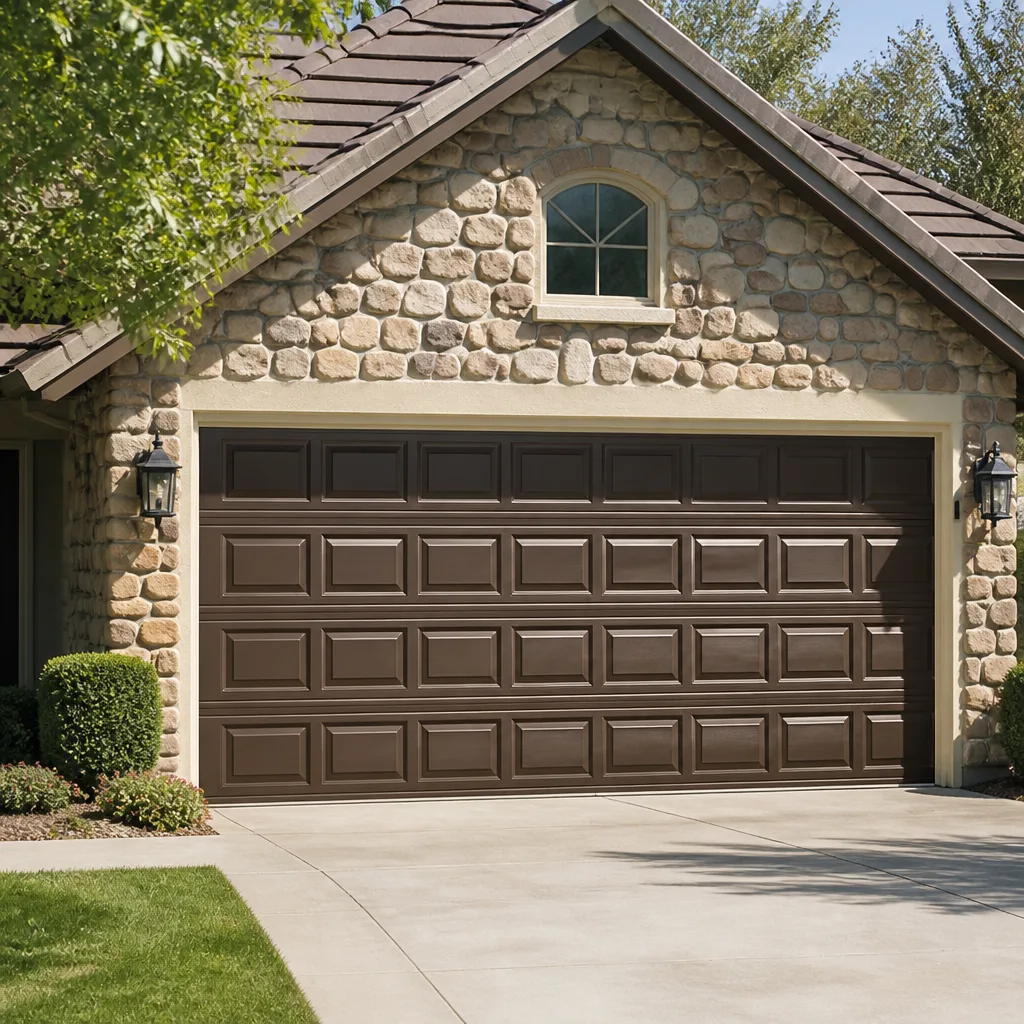 Raised-panel steel
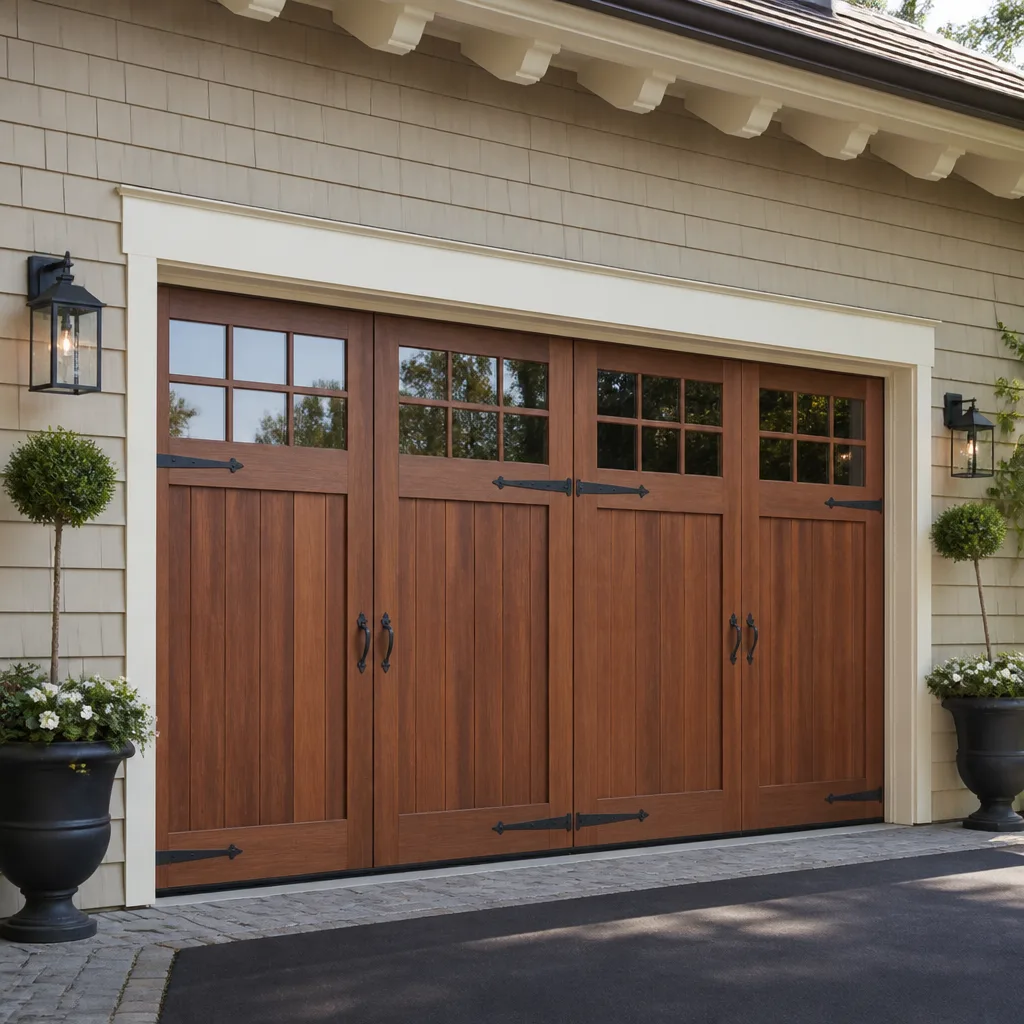 Carriage house
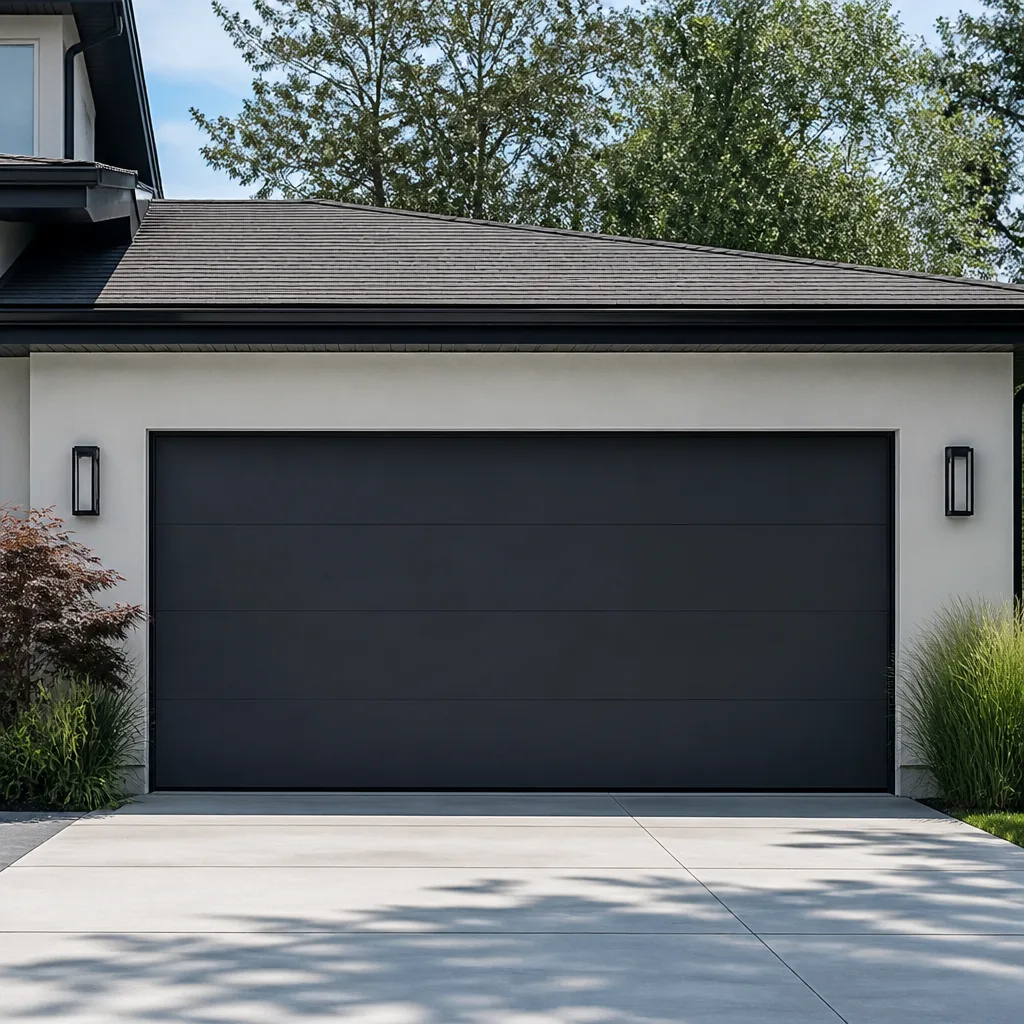 Modern flush
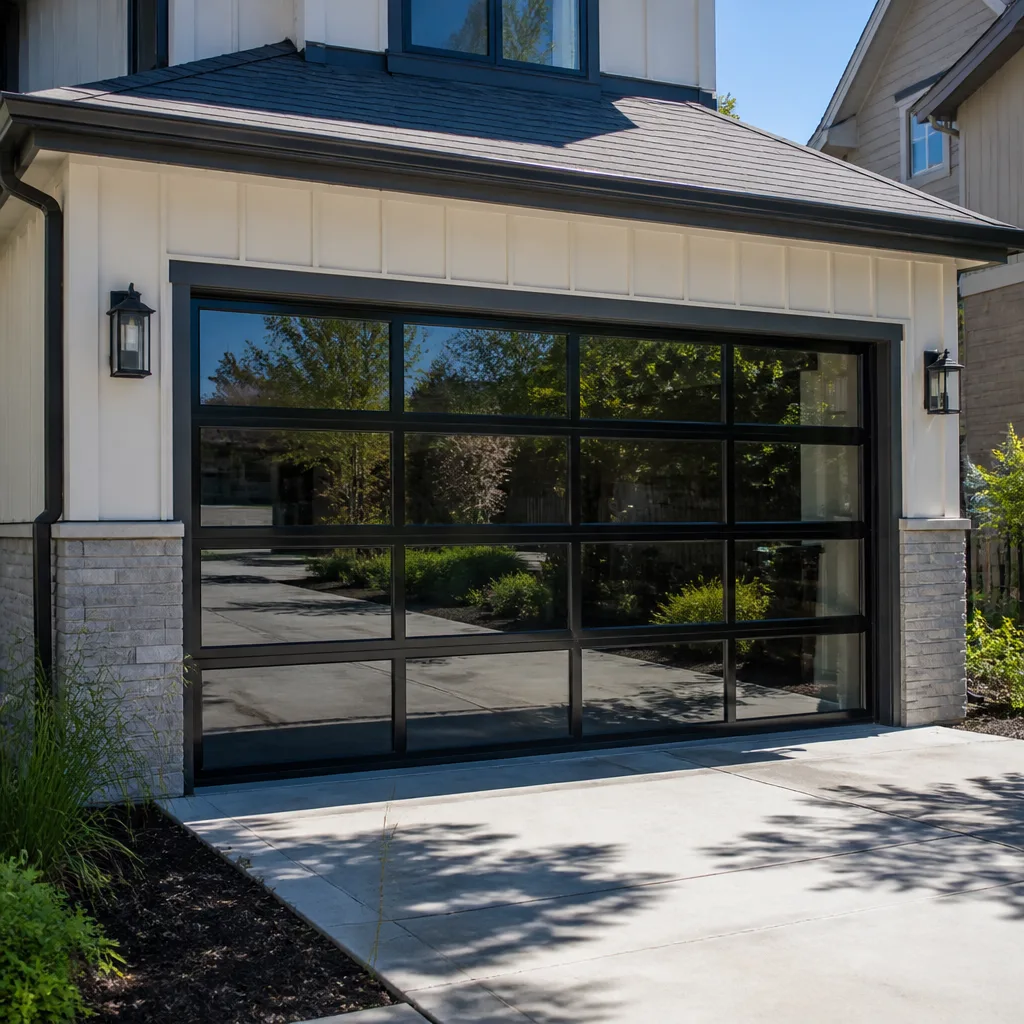 Full-view glass
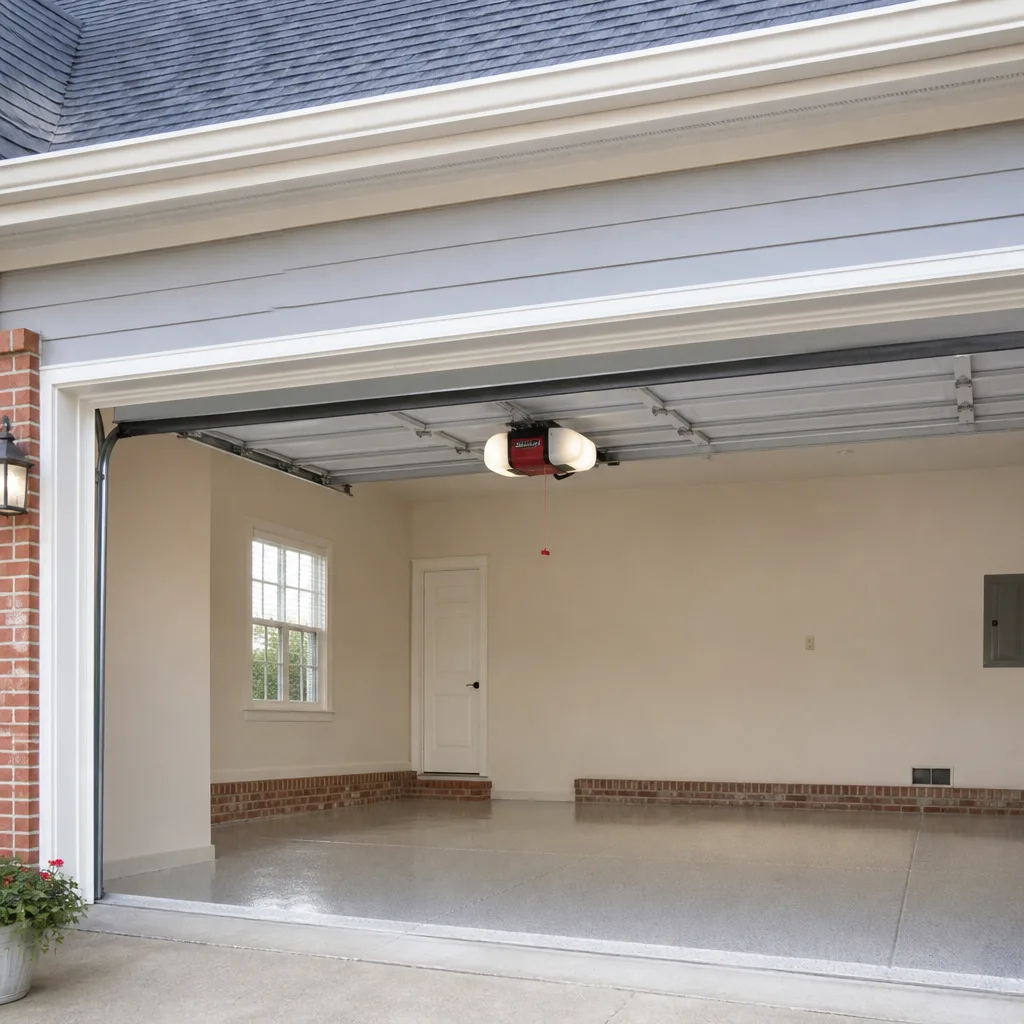 LiftMaster openers
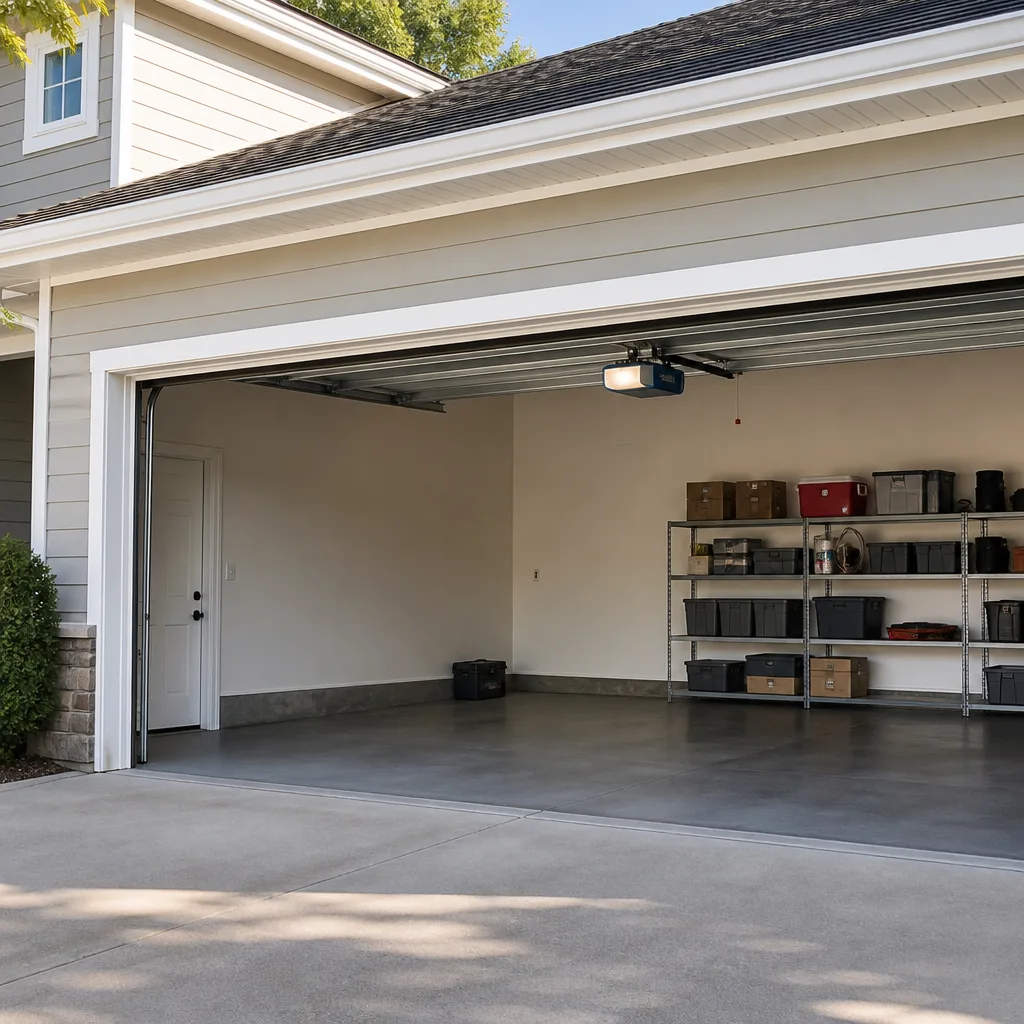 Chamberlain openers
Full 25-point door and opener safety check with every visit - springs, cables, rollers, tracks, and your LiftMaster or Chamberlain opener included
You get a price before we start. It does not change when the truck arrives.
Get your free estimateThe Complete Guide to Garage Door in San Marcos
The average San Marcos homeowner calls a garage door technician for the first time only after the door won’t open. By that point, a spring that could have been replaced for under $150 during routine maintenance has turned into a same-day emergency call that often runs three times the cost. The garage door is the largest moving object in your home, cycles open and closed more than 1,000 times a year, and yet it receives less attention than a kitchen faucet. This guide explains how the entire system works, what fails first, what it costs to fix in San Marcos, and how to make a repair-or-replace decision without getting upsold. Knowing the system before it breaks changes the math entirely.
Quick Answer
A garage door system in San Marcos has five mechanical zones that wear at different rates: springs (7 to 10 years), rollers and hinges (5 to 7 years), cables and drums (8 to 12 years), tracks (15+ years with alignment checks), and the opener (10 to 15 years depending on drive type). Most repairs cost between $120 and $400 for component-level fixes, while full door replacement in San Marcos typically runs $1,400 to $3,800 including installation. If you hear grinding, see a door hanging unevenly, or have a spring that snapped, call (877) 265-5166 for a free estimate before the secondary damage spreads to cables, drums, or the opener itself.
Styles & brands we work with
Table of Contents
- Anatomy of a Garage Door System: What Each Part Does, What Fails First
- San Marcos-Specific Factors: Marine Layer, Temperature Swings, and Material Performance
- Repair or Replace: How to Assess Your Door’s True Condition
- Springs Explained: Torsion vs. Extension and Why It Matters
- Garage Door Openers: Drive Types, Electronics, and When to Upgrade
- Brand Landscape: LiftMaster, Clopay, Wayne Dalton, Amarr, and Parts Availability in San Marcos
- The Full Service Arc: Repair, Maintenance, Opener Upgrades, and Installation
- Common Mistakes to Avoid
Anatomy of a Garage Door System: What Each Part Does, What Fails First
Every residential garage door, whether it’s a Clopay steel panel door in San Elijo Hills or a Wayne Dalton wood-look door in Lake San Marcos, runs on the same basic architecture. When we arrive at a house in San Marcos, the first thing we do is identify which zone is failing. Here’s the breakdown, in order of how frequently we replace each component:
The Springs (Fail First, Most Dangerous)
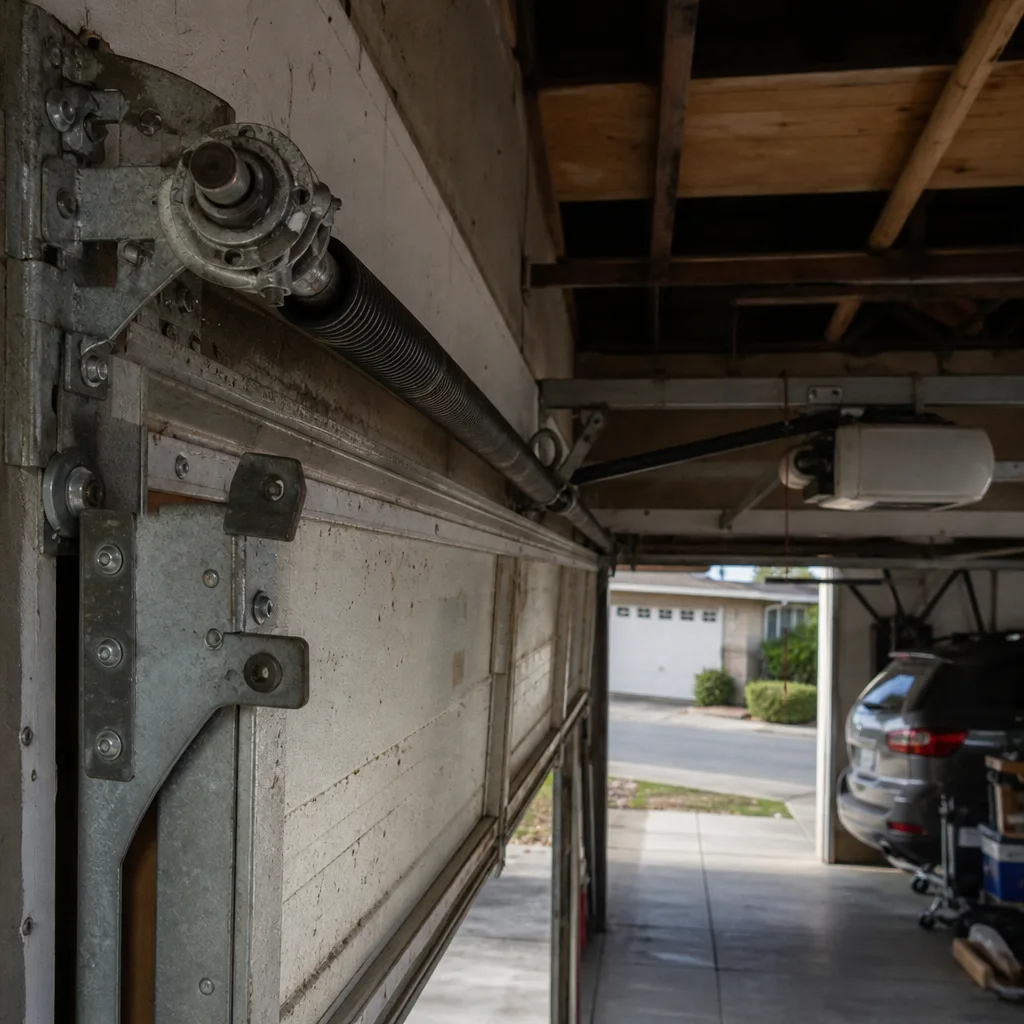
Your door’s weight, typically 130 to 220 pounds for a standard two-car door, is counterbalanced by springs, not lifted by the opener. The opener is just a motor that pushes the door along. If springs are weak or broken, the opener strains against dead weight, and that’s how a $60 opener gear gets stripped. Torsion springs, mounted on a shaft above the door, wind and unwind to store mechanical energy. Extension springs, mounted along the horizontal tracks on older doors, stretch and contract. In our experience, torsion springs snap between 10,000 and 15,000 cycles, which for most San Marcos households translates to 7 to 10 years. Extension springs fail a bit earlier, usually 6 to 8 years.
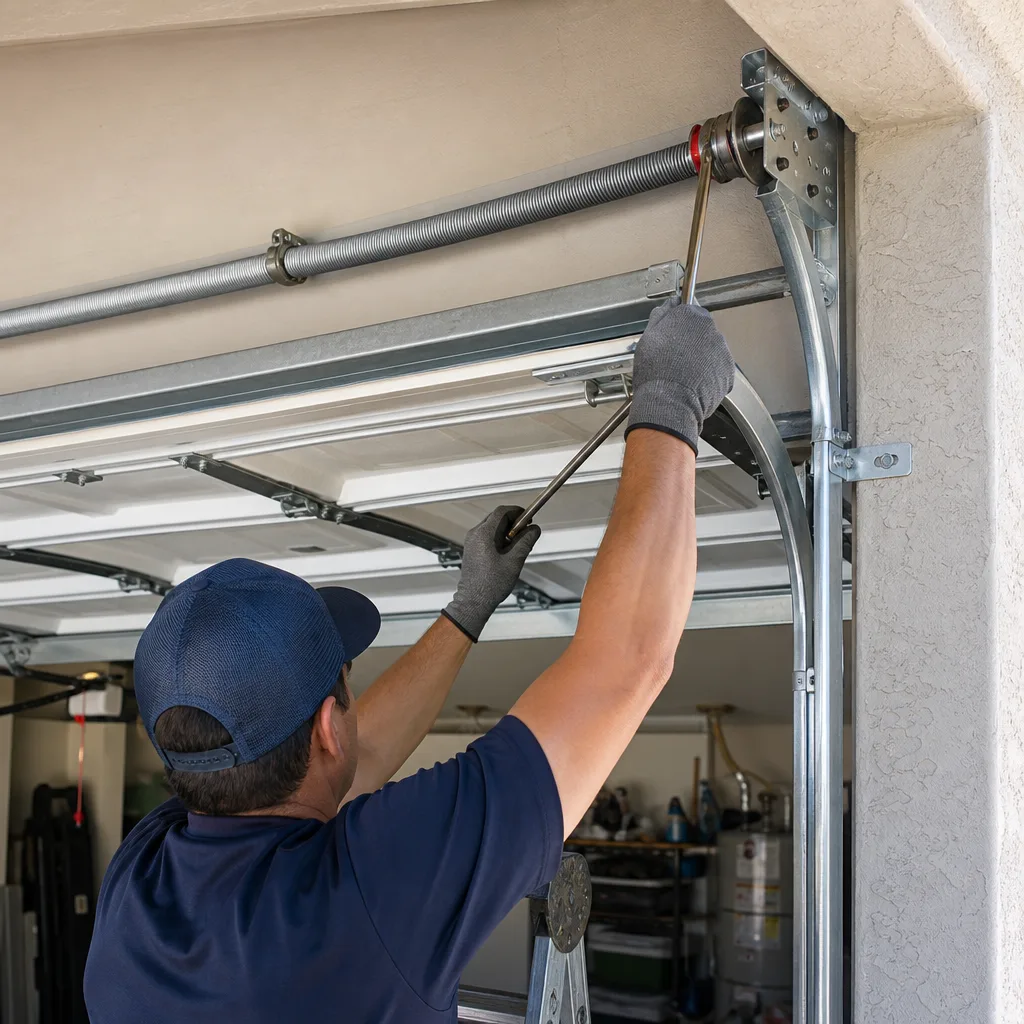
Safety note: torsion springs are under extreme tension. A snapping spring can cause serious injury, and attempting to wind or unwind one without the proper winding bars and training is genuinely dangerous. This is not a DIY repair. We carry clamped, factory-spec springs for all major door brands, so the replacement matches the door’s weight and lift characteristics, not a generic size off a shelf.
Cables and Drums (Fail Second, Often Because of Springs)
Galvanized steel cables, typically 1/8 inch thick, run from the bottom brackets on either side of the door up to drums at the top of the shaft. When a spring snaps and the door drops unevenly, one cable often jumps the drum or frays against the track. Once a cable is frayed, it’s a time bomb. We replace cables in pairs, always, because the unfrayed one has already stretched to match its partner and will fail within months. The drum, a cast aluminum or steel spool that winds the cable, rarely fails on its own. It fails when a bad spring causes the cable to bind and chew into the drum’s groove.
Rollers and Hinges (Fail Third, The Noise Makers)
Nylon rollers with sealed bearings last about 5 to 7 years before they develop flat spots and start to grind. Steel rollers last longer but are louder and rougher on the track. Hinges, especially the bottom hinge that takes the most lateral stress when a door opens partially and stalls, bend over time. When we hear squealing, popping, or a metallic grinding sound from a door in San Marcos, it’s almost always rollers and hinges. On a door with minor panel damage but good bones, replacing all rollers, hinges, and the bottom bracket is a $250 to $400 repair that can add five years to the door’s lifespan.
Tracks (Fail Last, But Misalignment Is Common)
Vertical and horizontal tracks are aluminum or galvanized steel. They don’t wear out so much as get knocked out of alignment, usually when someone backs into the door or when a cable failure yanks the bottom panel sideways. A door that shudders halfway up, or that binds at the same point every time, usually has a track issue. Track replacement is rarely necessary; a proper service includes checking plumb and level with a 6-foot level and resetting anything that’s drifted, along with checking the track radius where vertical meets horizontal. That’s where most binding occurs.
The Opener (Longest-Lasting, Most Electronics)
An opener from LiftMaster or Chamberlain will typically run 10 to 15 years before the logic board, capacitors, or drive gear fail. What we see most often in San Marcos is that the opener isn’t dead, it’s mispaired. The safety sensors at the bottom of the track get knocked out of alignment by bikes, garbage cans, or accumulated dust, and the opener refuses to close. Or the travel limits drift and the door stops a foot short of the floor. We do a full opener diagnostic before recommending replacement, because roughly half the time the “broken” opener needs a sensor realignment or a travel-limit adjustment, not a new motor.
If you’re wondering where to start, check the San Marcos Garage Door Service home page for a quick overview of what a full-system inspection covers.
San Marcos-Specific Factors: Marine Layer, Temperature Swings, and Material Performance
San Marcos sits inland enough to avoid the heaviest coastal fog, but the marine layer still reaches neighborhoods like Santa Fe Hills and Discovery Hills on summer mornings. That humidity, combined with 30-degree temperature swings between night and afternoon in the fall, creates a corrosion pattern we don’t see in Poway or Escondido. Here’s what actually matters for your door in this climate:
Humidity and Metal Fatigue
Morning condensation settles on unwaxed torsion springs and ungreased hinges. Over a decade, that dew cycle accelerates rust, and rust is the single biggest factor in premature spring failure. A spring that would last 12 years in Phoenix lasts 8 in San Marcos. The countermeasure is simple: springs should be checked for surface rust once a year and treated with a lithium-based lubricant, not WD-40, which displaces the proper grease. We also recommend nylon rollers with sealed bearings. They don’t care about humidity. Steel rollers, particularly zinc-plated economy rollers, will start spitting brown rust streaks within three years near the coast.
Track Lubrication and Dust
San Marcos has stretches of fine, silty dust, particularly around the hills near Cal State San Marcos. That dust mixes with grease on the track and forms a paste that loads up the rollers. A garage door that sounds like it’s dragging a bag of rocks usually has contaminated track lubricant. The fix is a cleaning with a solvent-based degreaser, then re-lubricating only the hinge points and roller bearings, not the track itself. Greased tracks collect dirt. Dry tracks are how the door is designed to run.
Which Materials Hold Up Best in San Marcos
For door panels, our honest assessment after years of working in this climate: steel with a polyester finish holds up best. A Clopay or Amarr steel door with an insulated core will show minimal rust over 15 years if the bottom edge is kept clean. Wood doors, especially anything custom-finished, require annual resealing and will warp in the humidity cycle between the marine layer mornings and the dry afternoons. Wood-look composite doors, like Wayne Dalton’s composite panel line, give the appearance without the maintenance. Aluminum doors dent easily and we rarely recommend them for a busy family garage in San Marcos. This is one of the key differences between a city like Garage Door Repair in San Clemente, where salt air is a dominant factor, and San Marcos, where the climate is more moderate but still demands maintenance discipline.
Repair or Replace: How to Assess Your Door’s True Condition
This is the question every San Marcos homeowner should ask before an emergency, and the answer is never a slogan. It’s a calculation based on your door’s age, its cycle count, what’s already been replaced, and what panels are doing. Here’s how we assess it, step by step:
- Determine the door’s age. Most steel doors have a date stamp or manufacturer code on the inside of the bottom panel or on a sticker near the top of the frame. If the door is older than 15 years, you’re on borrowed time for hardware even if the panels look fine.
- Count the cycles it’s seen. A door that opens 4 times a day (2 open, 2 close) runs about 1,460 cycles per year. Springs rated for 10,000 cycles last about 7 years at that rate. If your household has multiple cars, teenagers, and a home gym in the garage, you might be running 6 to 8 open/close movements daily, which puts you at 2,900 cycles a year. Springs fail twice as fast on a busy door.
- Check the bottom panel. The bottom panel takes all the moisture from a wet garage floor and is the first to rust through or rot. If the bottom panel is rusting from the inside out, you need a panel replacement, and you need to match the panel stamp. If the manufacturer no longer makes that stamp, you’re looking at a full door. This is the most common replacement trigger we see in San Marcos.
- Look at the door balance. Disconnect the opener (pull the red release cord) and lift the door by hand. It should lift with roughly equal effort through the whole arc and stay in place at half height. If it drops, the springs are weak or dead. If it’s heavy at the top, the springs are still partially wound but not matched to the door.
- Listen to the door. A door in good mechanical condition is quiet except for the opener’s motor and a soft rolling sound. Grinding means rollers. Squeaking means hinges or springs. Rattling means loose hardware or worn rollers bouncing in the track.
- Total up the repair load. As a rule of thumb: if the cost to repair springs, cables, rollers, and the bottom panel exceeds 50% of a new installed door, replacement is the better financial decision. We’ll tell you that directly, because a repair that buys you 18 months isn’t a repair, it’s a down payment on a replacement.
For a more detailed cost breakdown, our Garage Door Installation in San Clemente page explains the full selection and installation process, including what separates a quality installation from a cheap one.
Springs Explained: Torsion vs. Extension and Why It Matters
Springs are the most misunderstood part of a garage door. Most homeowners think the opener does the heavy lifting. It doesn’t. The opener’s motor produces enough torque to move a door that weighs about 15 to 20 pounds at the handle. The springs neutralize the other 170 or so. That’s why a door with a broken spring won’t open even with the opener running. The motor simply stalls or strips its gear trying to lift dead weight.
Torsion Springs: The Modern Standard
Torsion springs sit on a steel shaft above the door, usually in pairs for a two-car door. They twist, not stretch. Each spring is rated for a specific number of cycles (10,000, 20,000, or higher), and the spring’s wire gauge, inner diameter, and length are calculated against your door’s exact weight. A door with an insulated Clopay panel and glass inserts might weigh 40 pounds more than an uninsulated door of the same size, and the springs must be wound accordingly. When we install torsion springs on a door in San Marcos, we use a cycle-count-matched pair, never a single spring, because a single spring failure on a two-spring door causes asymmetric cable wear.
Extension Springs: Older Doors, Different Failure Mode
Extension springs are mounted along the horizontal tracks and stretch when the door closes. You’ll see them on doors installed before about 2005, and they’re still common on Wayne Dalton and older Craftsman-door systems. Extension springs have a critical difference: they should always have a containment cable running through the center. If an extension spring snaps and there’s no containment cable, the broken end whips through the garage. If your door has extension springs, check today whether those safety cables are present. If they’re missing, call a professional before the next cycle.
Spring replacement cost in San Marcos: expect $180 to $340 for a standard torsion spring pair replacement on a two-car door, including the springs, winding, balance check, and a cycle test. Extension spring replacement runs $150 to $250. The price is quoted and agreed before any work starts. No surprises on the invoice.
If you hear a loud bang from the garage and find the door uneven, one spring has snapped. Don’t run the opener. The unbalanced load will damage the cables, the drums, and the opener’s gear in under a minute. Call us at (877) 265-5166 and we’ll have a technician out to you in San Marcos the same day.
Garage Door Openers: Drive Types, Electronics, and When to Upgrade
Garage door opener technology changed more in the last ten years than in the previous forty. The openers on most walls today, from Chamberlain, LiftMaster, and Genie, are full computers with logic boards, DC motors with soft-start and soft-stop, and encrypted wireless protocols. Here’s what you need to know, by drive type:
Chain Drive
A steel chain pulls the trolley along a rail. Chain drives remain the most common because they’re inexpensive to produce and extremely durable. They’re also the loudest. If your garage is under a bedroom or adjacent to a living space in a San Marcos townhome, a chain drive will announce itself every time. Still, a quality chain drive from LiftMaster will outlast most belt drives by a few years because steel wears slower than reinforced rubber.
Belt Drive
A steel-reinforced belt, usually polyurethane over fiberglass or steel, pulls the trolley. Belt drives are dramatically quieter, nearly silent on the rail itself. Chamberlain and LiftMaster both build belt drives with lifetime belt warranties on their upper-end models. For an attached garage in San Marcos, this is our default recommendation when quiet operation matters.
Screw Drive
A threaded steel rod rotates to move the trolley. Fewer moving parts than a chain or belt, but the screw requires more maintenance and is sensitive to temperature swings. In San Marcos, where summer garage temperatures can hit 110 degrees, a screw drive will operate more stiffly in cold winter mornings and more loosely in peak heat. Genie built the category. We service them regularly, but we recommend belt or chain drives for new installations unless the buyer specifically wants a screw drive.
Direct Drive and Jackshaft
Jackshaft openers, like the LiftMaster 8500W, mount on the wall beside the door and drive the torsion shaft directly rather than pulling from the ceiling. They free up ceiling space and are nearly silent. They require a properly balanced torsion spring system and are more expensive to install. For high-lift doors or garages with low ceilings, they’re the only practical choice. We install and service them, and we strongly recommend a professional installation because the torque at the shaft requires careful calibration with the door’s balance.
Opener repair is a distinct specialty. A technician who services openers all day knows the board-level diagnostics, the sensor alignment procedures, and the compatibility matrix between openers and doors that a general handyman doesn’t. If your opener runs but the door won’t move, or if the opener refuses to close and the lights blink, the issue is usually a safety sensor, a limit switch, or a logic board fault. We troubleshoot those before recommending a replacement. More detail on that process is on our Garage Door Opener Repair in San Clemente page.
Brand Landscape: LiftMaster, Clopay, Wayne Dalton, Amarr, and Parts Availability in San Marcos
We work on all of them, and we’re factory-familiar with the parts catalogs and failure patterns for each. That matters because a Chamberlain opener on a Clopay door has different adjustment needs than a Genie opener on a Wayne Dalton door. The combination in front of us determines the fix. Here’s our honest field assessment:
LiftMaster and Chamberlain
Same parent company (Chamberlain Group), different distribution channels. LiftMaster is sold through dealers and installers. Chamberlain is the retail brand you’ll find at big-box stores. The core motors, logic boards, and rails are essentially the same. Parts for both are widely available in San Marcos, either same-day from local suppliers or within 24 hours. If you’re choosing between them, know that a LiftMaster installed by a dealer carries a stronger parts warranty than a Chamberlain bought off the shelf and installed by a generalist. We service both equally.
Clopay
Clopay builds a massive range of steel and wood doors, from entry-level single-layer panels to insulated, wood-overlay premium doors. Panel stamp consistency across years is generally good, which means a bottom panel replacement on a 12-year-old Clopay door is often feasible. Parts availability for hinges, struts, and bottom brackets is excellent in the San Marcos market. When we see a Clopay door fail, it’s usually weather seal and panel edge rust, not hardware.
Wayne Dalton
Wayne Dalton’s TorqueMaster spring system, which encases the torsion spring inside a tube, is a design we work on frequently. It’s safe but service-intense, because the spring can’t be visually inspected without opening the tube. If your Wayne Dalton door has a TorqueMaster and the door suddenly feels heavy, call us. We’ll open the tube, inspect the spring, and either re-tension or convert to a standard torsion setup if the TorqueMaster is at end-of-life. Wayne Dalton doors also use a unique bottom bracket, so generic brackets don’t fit. Wrong-part installations are the most common issue we fix on Wayne Dalton systems.
Amarr
Amarr doors, particularly through the dealer channel, spec high on hardware quality. Hinges, rollers, and track are typically one grade above the entry-level competition. Amarr’s sectional steel doors hold up well in San Marcos’s humidity because the panel edges are hemmed and sealed more thoroughly than some competitors. Parts availability is good but not as universal as Clopay, so for unusual panel sizes there can be a 3 to 5 day lead time. We’ll tell you that upfront if we’re pricing a panel replacement.
What About Craftsman and Raynor?
Craftsman door openers, which rebadged Chamberlain and LiftMaster units for decades, are still on many San Marcos garage ceilings. We service them as though they’re the underlying brand, and parts are typically interchangeable with Chamberlain equivalents. Raynor doors are less common in Southern California, but they’re well-built and we service their complete hardware line. If you have a Raynor door with an unusual spring configuration, we can source the exact spring rather than making a generic one work.
Brand-agnostic diagnostics are the core of our service model. We don’t show up with a clipboard of what we’d like to sell. We show up with the parts truck that covers the brands on your wall.
The Full Service Arc: Repair, Maintenance, Opener Upgrades, and Installation
Most garage door companies in San Marcos do one thing well. A spring-repair shop will swap your springs and leave. An installation company will measure you for a new door and wait six weeks. The problem is that garage door systems don’t fail in single-component isolation. A broken spring that goes unaddressed for two weeks takes out the cables. A misaligned track that gets ignored grinds the rollers and bends the hinges. A door that’s out of balance strains the opener until the gear strips. When you’re dealing with a system, you need a service provider who can handle all of it. Here’s the full service arc, and what triggers each stage:
Stage 1: Same-Day Repair
What triggers it: a snapped spring, a frayed cable, a door that’s come off its track, a bottom panel that’s rusted through, a door that won’t open or close. We prioritize these calls because each day of deferred repair creates secondary damage. A cable that frays on Tuesday and gets fixed on Friday will have taken out the drum by then. We stock torsion springs across the full weight range, cables in multiple lengths, rollers in both nylon and steel, and bottom brackets for the major brands. Most component-level repairs are completed in one visit. The price is quoted and agreed before any work starts, always.
Stage 2: Scheduled Maintenance
What triggers it: the door is functioning but noisy, or you’ve owned it for five years without a service call. A maintenance visit includes a spring-cycle check, cable inspection, roller and hinge inspection, track alignment check, opener force-limit test, and sensor alignment. We lubricate the pivot points, not the track. A maintenance visit in San Marcos costs between $95 and $150 and is the single cheapest way to avoid an emergency call. We recommend it once a year for doors over ten years old, and once every two years for newer doors.
Stage 3: Opener Upgrades
What triggers it: your opener still runs but it’s loud, lacks security features, won’t pair with a smart-home hub, or keeps failing sensor tests. An opener upgrade replaces the motor, rail, sensors, and wall console, often reusing the existing wiring. The upgrade takes 2 to 3 hours. If you’re moving from a chain drive to a belt drive, or adding a jackshaft opener, we’ll clarify the load requirements and confirm your door’s spring balance before installation. An opener can’t compensate for a badly balanced door, and installing a new opener on weak springs just shortens the new opener’s life.
Stage 4: Full Door Installation
What triggers it: the door is over 15 years old, the bottom panel is rusted through, the track is out of spec, or you want to upgrade insulation, appearance, or material. A full installation includes removing the old door, installing new track, springs, cables, drums, hinges, rollers, weather seal, and the door panels, then reconnecting or replacing the opener and doing a full balance and safety test. We’ll walk you through material options side by side so you understand what you’re paying for. Installation is measured and scheduled, not same-day. You’ll get a written price before the work starts, and that price doesn’t change when we see the existing door. We see the door at the measure, not after the quote.
Common Mistakes to Avoid
- Running the opener after a spring snaps. The opener will strip its gear or fry its logic board trying to lift an unbalanced door. Disconnect the opener and call a technician. The repair bill doubles when the spring failure takes the opener with it.
- Lubricating the track. Garage door tracks are designed to run dry. Oil or grease on the track attracts San Marcos dust and creates a grinding paste that destroys rollers. Lubricate the hinges, springs, and roller bearings only.
- Replacing only one spring. Springs wear on the same cycle count. If one snaps at 12,000 cycles, the other has 12,000 cycles on it too. Replacing both at once costs less than two service visits and prevents a follow-up failure.
- Ignoring a noisy door. Grinding, popping, or squealing is not a personality trait. It’s a component telling you it’s failing. A noisy roller becomes a locked-up roller, which then drags and bends the track. Noise is an early warning that repair is still cheap.
- DIY-ing spring repair. Torsion springs store enough energy to break bones or worse. The winding bars, the correct spring size, and the calibration process are not something to learn from a video. This is the one repair we’ll always tell you to leave to a trained professional, and we’re not protecting a monopoly, we’re being honest about the risk.
- Choosing a door based on appearance alone. The prettiest door on the showroom floor might be a wood door that requires annual resealing in San Marcos’s humidity, or an aluminum door that dents when a bicycle leans on it. Material choice should follow how the garage is used, not how the door looks in a catalog photo.
- Accepting a quote without a site visit. A company that quotes a full door installation over the phone hasn’t seen the track condition, the headroom, the spring setup, or the opener configuration. We measure and inspect before we price. A phone quote for a full installation is usually an estimate, and estimates have a way of growing on install day.
See the difference
 Before
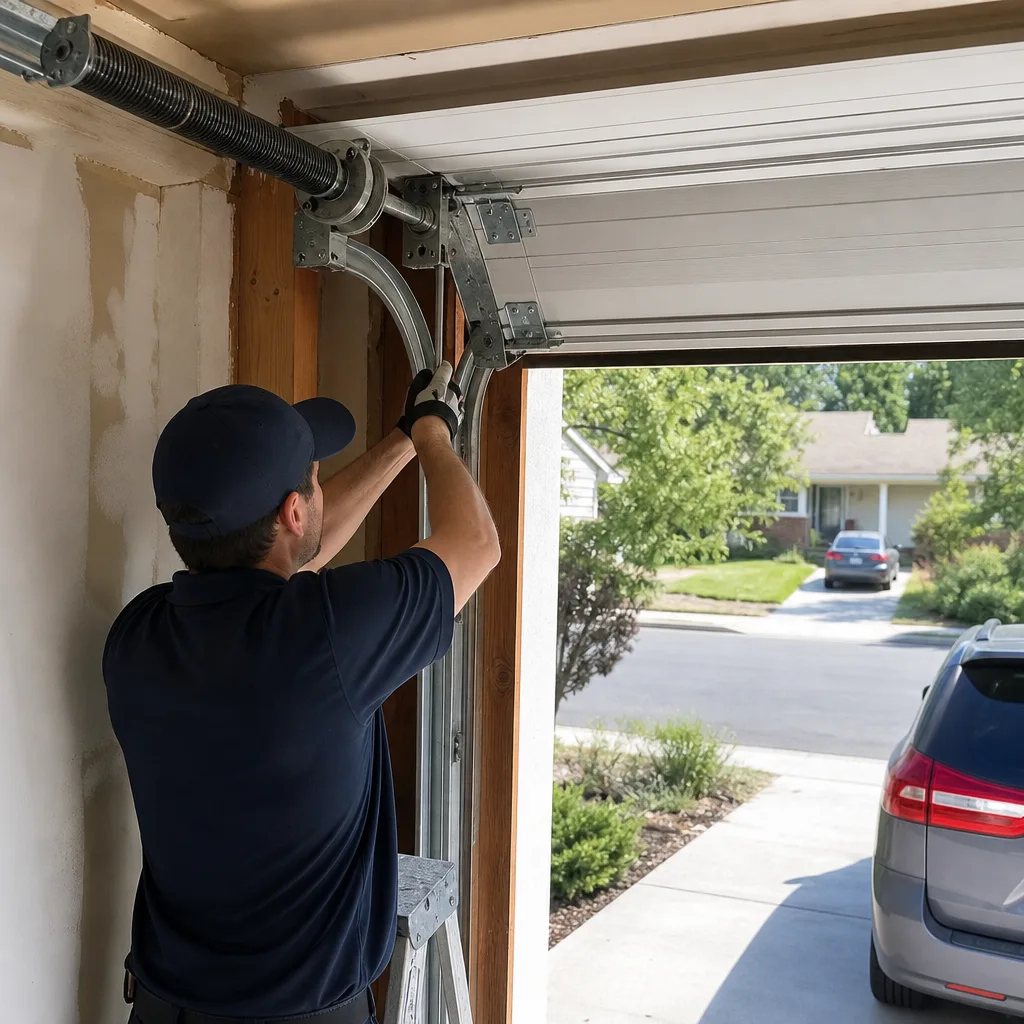 After
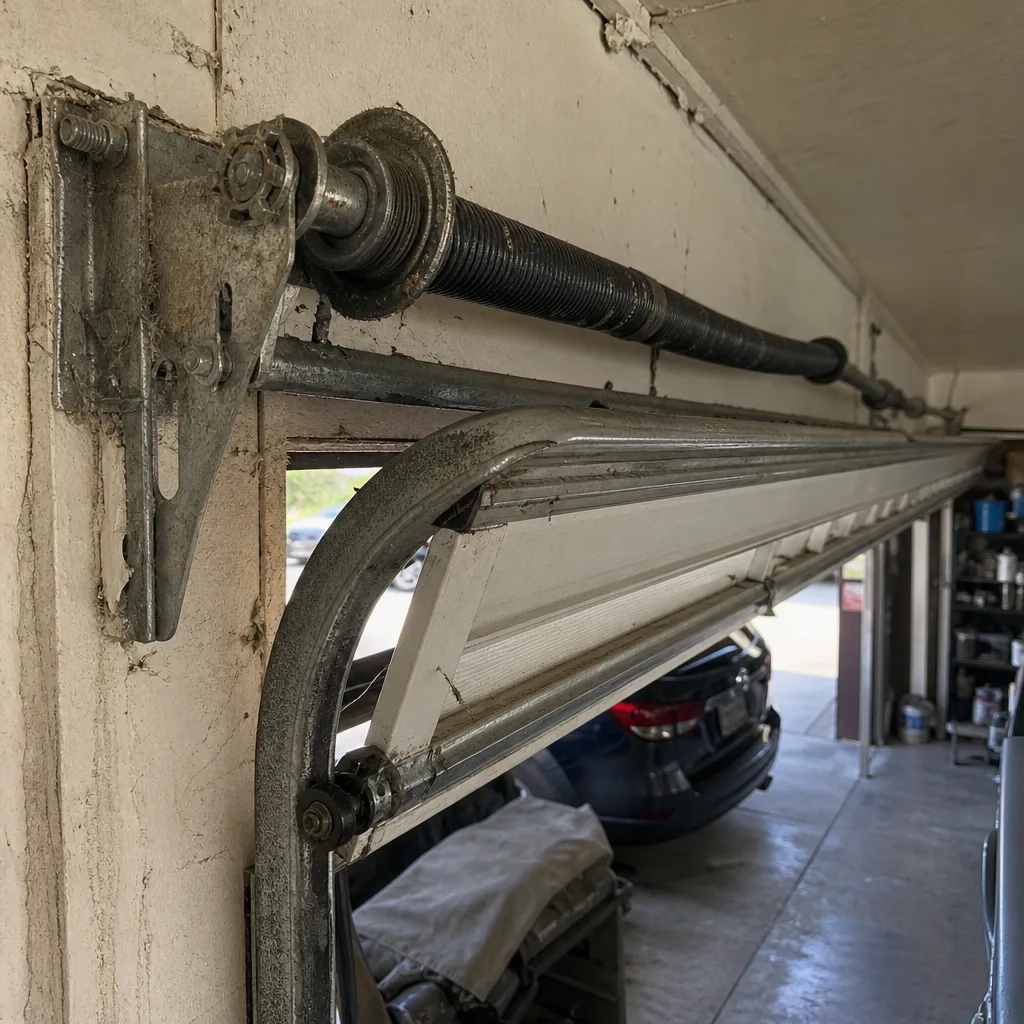 Before
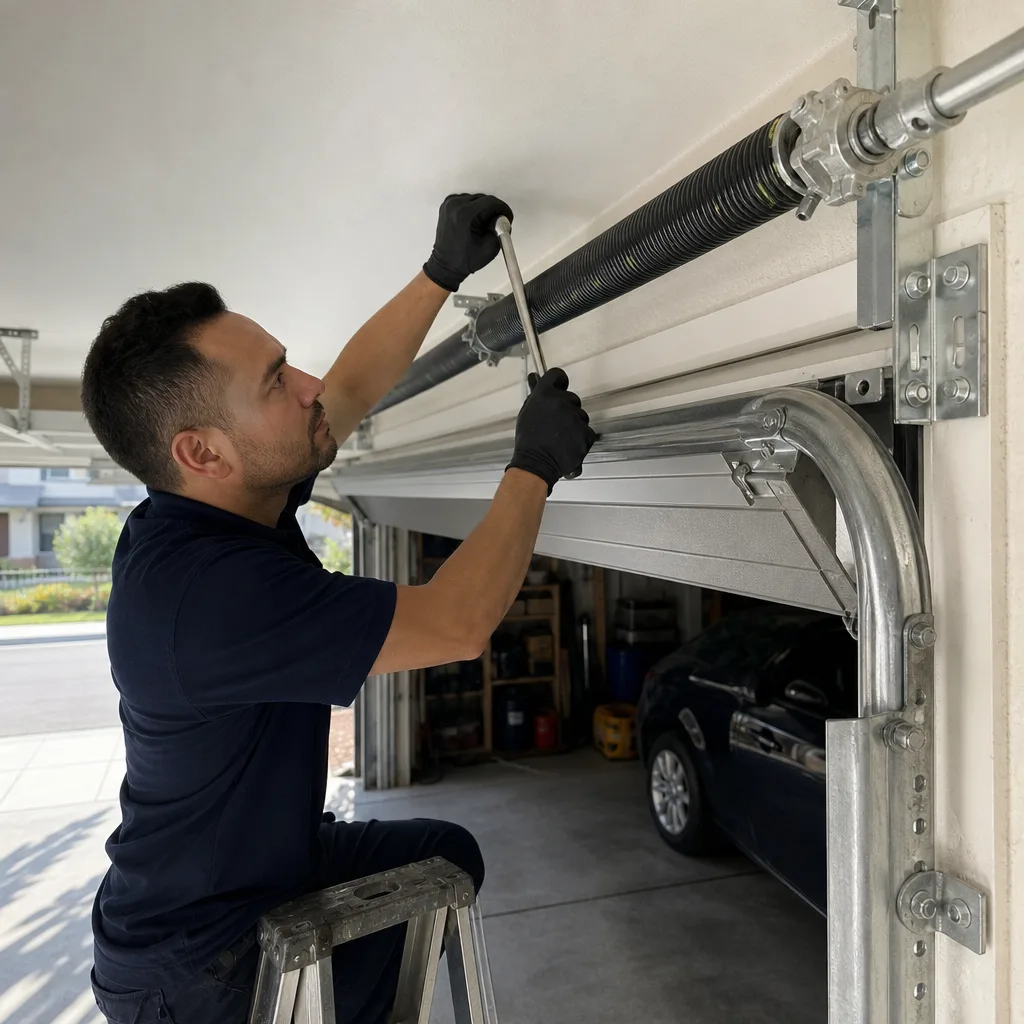 After
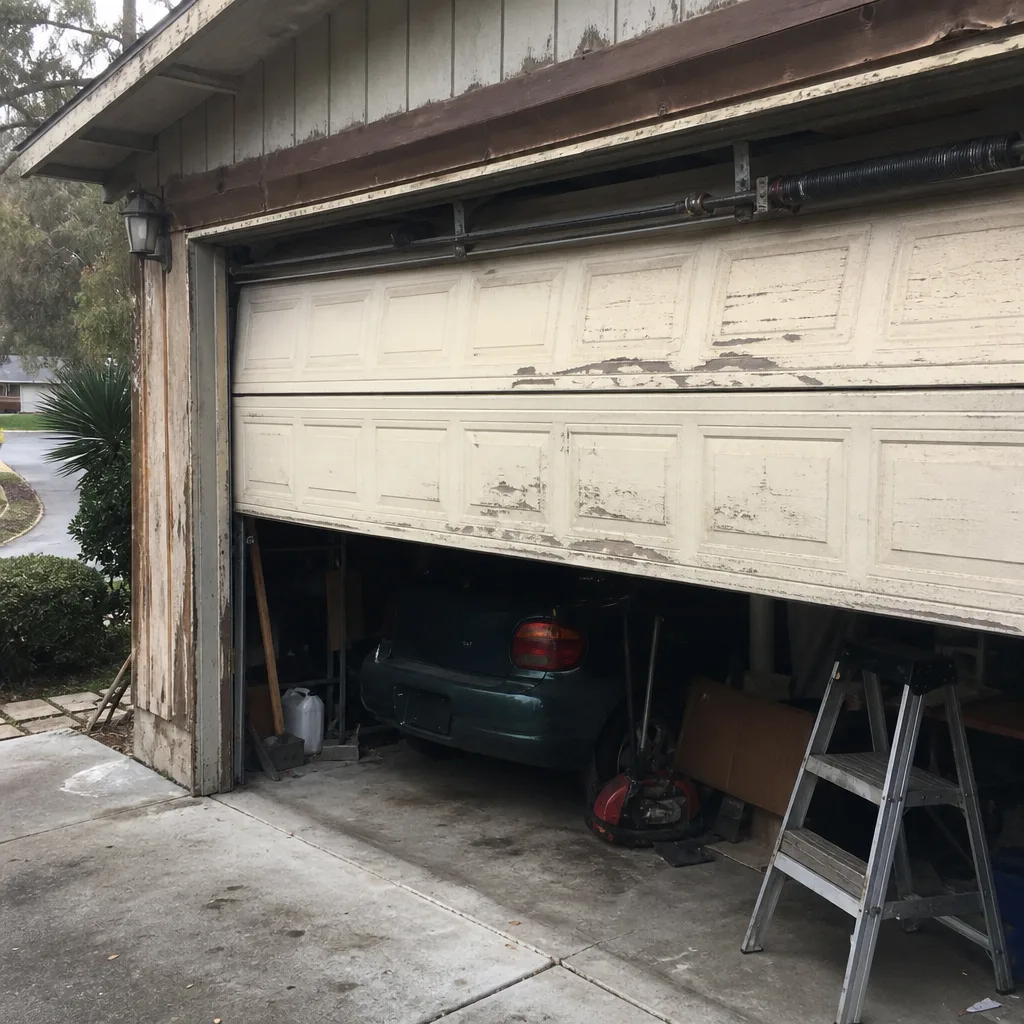 Before
 After
When to Call a Professional
A garage door is safe when all five zones (springs, cables, rollers, tracks, opener) are in balance. It becomes dangerous when any one of them fails and you keep using the door. Call a professional when you hear a loud bang from the garage, when the door hangs unevenly or drops when released from the opener, when a cable looks frayed, when the bottom panel shows rust-through, or when the opener refuses to operate the door despite running. The longer you wait, the more components fail, and the repair cost compounds. San Marcos Garage Door Service offers more guides & resources, plus free estimates throughout San Marcos. Call (877) 265-5166 and we’ll assess the whole system, not just the part that broke.
Frequently Asked Questions
Component-level repairs in San Marcos typically run $120 to $400: spring replacement averages $180 to $340, cable replacement $160 to $220, roller and hinge replacement $250 to $400 for a full set, and opener logic board or gear replacement $180 to $300. The price is quoted and agreed before any work starts. Call (877) 265-5166 for an exact quote based on your door’s make and model.
Yes, for emergency repairs like snapped springs, frayed cables, or doors off track, we offer same-day service across San Marcos including Santa Fe Hills, Discovery Hills, San Elijo Hills, and the Cal State San Marcos area. Repairs are the priority. Installations are measured and scheduled on a timeline that respects the preparation involved, not rushed into a same-day slot.
Snapped torsion springs, by a wide margin. The humidity cycle from morning marine layer to afternoon heat accelerates rust on springs that haven’t been lubricated, and a San Marcos door that cycles 4 to 8 times a day hits the 10,000-cycle spring limit faster than most homeowners expect. The second most common issue is a misaligned safety sensor that prevents the opener from closing.
Expect 7 to 10 years for a standard torsion spring on a single-family San Marcos home, assuming the door cycles 4 times a day. High-cycle springs rated for 20,000 cycles, which we recommend for busy households, will last 14 to 18 years. Extension springs on older doors fail earlier, typically at 6 to 8 years, and should have containment cables.
If the door needs a spring and cable replacement but the panels, tracks, and bottom seal are sound, repair it. If the bottom panel is rusting through, the door’s stamp has been discontinued, or the cumulative repair estimate exceeds 50% of a new installed door’s cost, replace it. We’ll give you that calculation honestly, without steering you toward the bigger bill.
No. We quote a price after a site visit and a system assessment, and that price is the price. If we discover an additional issue during the repair that wasn’t visible at the quote, we stop and show you what we found before doing additional work. Nothing gets added to the invoice without your approval. Call (877) 265-5166 for a free, honest estimate.
The Bottom Line
A garage door is a mechanical system with predictable failure points, and in San Marcos, the humidity and usage patterns make some failures more predictable than elsewhere. Springs fail first, cables follow springs, rollers announce themselves with noise, and openers outlast everything else except their sensors. Knowing what each component does and what its lifespan is means you never overpay for a fix you didn’t need or underspend on a patch that leaves you back at square one. When the system does fail, deal with it the same day. Secondary damage is real, and it compounds. We work on every major brand, we stock the parts, and we’ll tell you honestly whether to repair or replace. Call (877) 265-5166 for a free estimate in San Marcos.
Written by the team at San Marcos Garage Door Service, serving San Marcos since 2012.